The Rising Trend of Stone Furniture in Modern Hospitality and High-End Residential Projects
Oct 15, 2026
Bottom Line Up Front
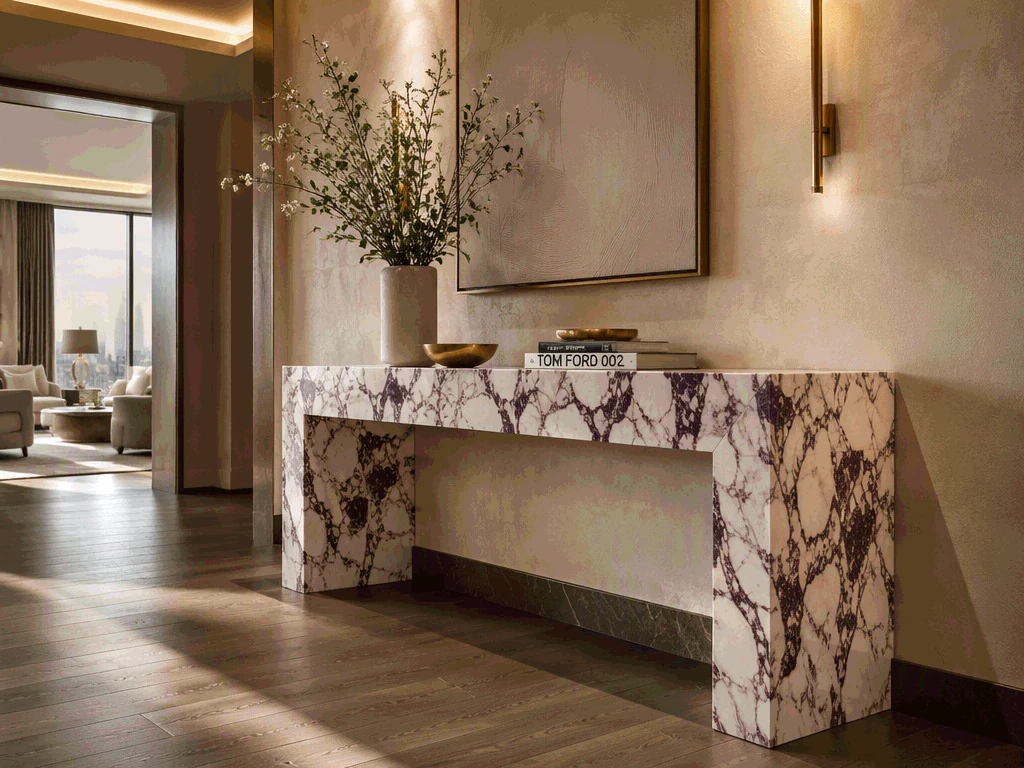
A solid marble console table is not a heavy object that happens to be furniture. It is a lever, and the number that decides whether it stays upright is the ratio between its base footprint and its top overhang, not its mass. A 1200 × 400 mm console in 20 mm Calacatta Viola panels resists the EN 1730 stability load with a 1.60× margin when the base sits flush with the top edge; inset that same base by 150 mm and the piece tips at 105 N, roughly 10.7 kg of hand pressure on the front edge. Three figures belong on the RFQ: mass by panel thickness, base inset in millimetres, and the mitre-face tolerance.
1. Why Stone Furniture Moved From Decoration to Specification
Through the 2010s a marble table meant a stone top on a metal or timber frame. In 2026 hospitality and high-end residential briefs increasingly ask for the stone to be the object: a single monolithic volume where the top folds over the end and runs to the floor. Hospitality trend reporting for 2026 describes the shift as "materiality with weight, and surfaces that make a space feel anchored rather than styled," with marble, stone and natural textiles used to build warmth rather than contrast.
That is a design intention, and it collides with physics. A stone top on a frame is carried by the frame. A monolithic console panel carries itself, so every dimension becomes a structural decision, and the base is no longer a detail chosen by the styling team.
Waterfall and mitred stone edges are decades old on fireplace surrounds and window sills. What changed in the last fifteen years is the tilting-head CNC bridge saw and the 5-axis waterjet, which hold angles tightly enough that a glued mitre reads as one piece on polished stone. A hand-cut mitre from the 1980s showed a gap or a visible seam line. On a well-cut CNC mitre today, you have to know where to look to find the joint.
The practical consequence for a buyer is that mitred furniture is now a repeatable factory product rather than a one-off artisan piece - which means it can be specified, tested and quoted the same way as any other cut-to-size item.
Printed quartz reproduces one reference block across 60 or more slabs at Delta E 1.0 or better per batch, and a repeat order placed 24 months later is pressed from the retained file. Natural marble offers the opposite property: the figure is unique per block and never repeats. Where a client is buying a signature piece rather than a matched run, that irreproducibility is the product.
The comparison below is the composition and property data this factory publishes for the three materials that reach a furniture project. Read it as a material-selection table, not as a ranking.
On price, one point is worth stating plainly to a buying team. Quarry-direct buying removes a margin layer only on the materials a supplier actually holds at the source; on everything else the block is bought at the same one-remove price everyone else pays, and the saving has to come out of yield and cutting efficiency instead. On a mitred console the yield is the real lever, because two full-depth end panels consume slab area that a plain top with a metal frame never would.
| Selection criterion | Engineered veined quartz | Natural quartzite | Natural marble (Calacatta Viola) |
|---|---|---|---|
| Composition | 90–93% crystalline quartz, 7–10% polyester resin | Metamorphic, quartz-dominant | Calcite or dolomite carbonate |
| Mohs hardness | 6–7 composite, 7 for the aggregate | 7 | 3–4 |
| Water absorption (ASTM C97) | Below 0.02% | 0.05–0.30% | 0.10–0.35% |
| Compressive strength (ASTM C170) | 190–220 MPa | 150–250 MPa | 70–130 MPa |
| Flexural strength | 45–55 MPa | 15–30 MPa | 8–20 MPa |
| Acid etch | No, inert to kitchen acid | No | Yes, below pH 7 |
| Surface heat limit | 120–150 °C, set by the resin binder | 600 °C and above | Thermal shock risk |
| Pattern repeatable | Yes, to Delta E 1.0 per batch | No, unique per block | No, unique per block |
| Sealing required | No | Above 0.10% absorption | Yes, at fabrication and on a maintenance cycle |
| Where it wins on a furniture project | Matched runs, high-traffic contract work | Thin tops, outdoor and heat-adjacent use | Signature pieces, bookmatched composition |
Published forecasts for the furniture segment behind this demand disagree by a factor of four - 2.05% CAGR to 2034 (Custom Market Insights, March 2025) against 9% CAGR to 2033 (industry trend analysis, 2026) - because each study bounds the segment differently. Treat market growth as a backdrop, not as a procurement input.
2. Console Table Mass, Base Geometry and Tip-Over Margin
A rectangular console and a round pedestal table fail differently, and it is worth separating them before specifying either. A circle on one pedestal is held at the middle, so the unsupported span is the radius and the governing check is bending across the stone. A rectangle in a waterfall build, such as a Calacatta Viola marble console table, is held down both ends, so the span is short and the governing check moves to tipping and to shear at the two mitre joints.
The figures below are calculated at 2.65 g/cm³, the mid-point of the 2.6–2.7 g/cm³ band published for calcite marble. Each console is a top plus two full-depth waterfall end panels 750 mm high.
| Console (W × D, mm) | Panel thickness | Top mass | Two end panels | Total piece mass |
|---|---|---|---|---|
| 1000 × 350 | 20 mm | 18.6 kg | 27.8 kg | 46.4 kg |
| 1200 × 400 | 20 mm | 25.4 kg | 31.8 kg | 57.2 kg |
| 1200 × 400 | 30 mm | 38.2 kg | 47.7 kg | 85.9 kg |
| 1500 × 450 | 20 mm | 35.8 kg | 35.8 kg | 71.6 kg |
| 1500 × 450 | 30 mm | 53.7 kg | 53.7 kg | 107.3 kg |
| 1800 × 500 | 30 mm | 71.6 kg | 59.6 kg | 131.2 kg |
Two things fall out of this table. First, mass is almost linear in thickness, so moving a 1200 × 400 console from 20 mm to 30 mm adds 28.6 kg - a 50% increase in what the delivery team has to lift and what the crate has to carry. Second, mass alone does not buy stability, which is the point of the next table.
EN 1730 applies a horizontal stability load V at the point of greatest overturning risk, 50 mm in from the edge and as far as possible from the pedestal. V₁ is 200 N where the longest side of the top in the direction of overturning is under 800 mm, rising to 400 N above 1600 mm; where the table is higher than 950 mm, only half of V is applied. A 1200 × 400 × 750 mm console takes the full 200 N, applied 350 mm from the front tipping line.
The resisting moment is the piece mass multiplied by the horizontal distance from the tipping line to the centre of gravity. Both sides of that ratio move as soon as the base is inset.
| Base depth behind the front edge | Centre of gravity behind the tipping line | Resisting moment | Overturning moment at V = 200 N | Margin |
|---|---|---|---|---|
| 400 mm, flush with the top edge | 200 mm | 112 N·m | 70 N·m | 1.60 |
| 350 mm, base inset 50 mm | 163 mm | 85 N·m | 70 N·m | 1.22 |
| 300 mm, base inset 100 mm | 124 mm | 60 N·m | 70 N·m | 0.86 |
| 250 mm, base inset 150 mm | 83 mm | 37 N·m | 70 N·m | 0.53 |
The counter-intuitive result is worth stating plainly. Insetting the base does two things at once, and both make the piece less stable: it removes mass, because the end panels get smaller, and it moves the centre of gravity rearward relative to the front tipping line. A designer who insets the base to make a console look lighter has done the opposite to its stability.
At a 0.53 margin the piece tips at 105 N, which is about 10.7 kg applied 50 mm from the front edge. A guest leaning on the front of a hotel corridor console with two hands will exceed that without noticing.
- Deepen the base, and deepen it forward. Restoring the 1200 × 400 console from a 250 mm to a 350 mm base returns the margin from 0.53 to 1.22. This is the cheapest fix because it uses material already in the cut list.
- Anchor the base. Where a console stands against a wall in a hotel corridor or a lobby, a bolted bracket or a stone plinth bedded to the floor removes the overturning case entirely. Specify this in writing; it is an installation requirement, not a shop option.
- Ballast the plinth. A hollow plinth filled with a stone offcut adds mass low down, where it works hardest on the resisting moment. It is the least visible fix, and it is the one to choose on a piece with a fixed architectural position.
Where you are specifying to a project standard rather than to a generic contract grade, the non-domestic loads are the ones that apply: BS EN 15372 puts 1250 N on the main surface, repeated ten times, against 1000 N for domestic tables, and it raises the horizontal durability cycle to 300 N repeated 15,000 times against 10,000. The relevant sequence is EN 1730 for the test methods, EN 12521 for domestic tables and EN 15372 for non-domestic.
3. The Waterfall Mitre: What "0.5 mm" Actually Means
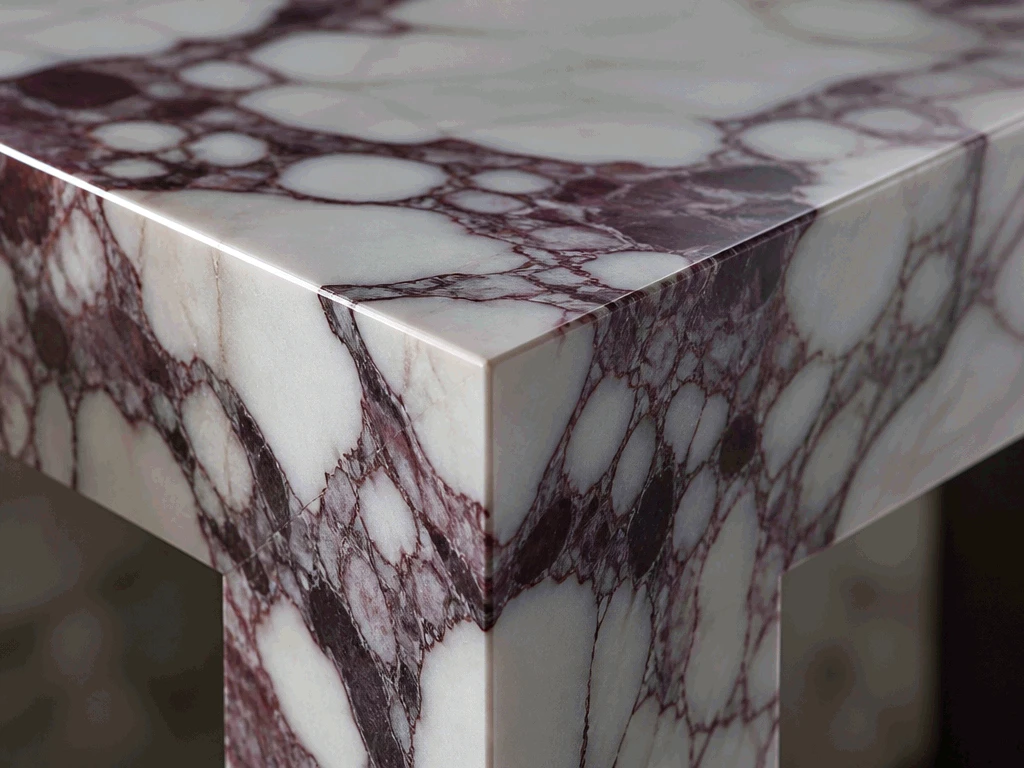
Most tolerance disputes on mitred stone furniture come from three different numbers being used as if they were the same one. They are not: they are measured at three different stages, on three different features.
| Measurement | Where it is taken | Working tolerance | Where the figure comes from |
|---|---|---|---|
| Mitre face gap, before adhesive | Across the full length of the joint, faces closed dry | 0.5 mm or less | Standard shop practice on waterfall work |
| Visible seam width, after finishing | On the finished face | 1/16 in (1.6 mm) ± 1/16 in | Published US shop tolerance schedule |
| Bookmatch mismatch at the joint line | At the joint line, on the assembly | 1 mm maximum | Published fabrication tolerance for this material range |
| Dimensional tolerance on the drawing | Any dimensioned feature | ±1 mm | Stated on the cutting drawing |
| Stone-to-wall gap | Between the stone and the wall or panel | 1/8 in ± 1/16 in | Published US shop tolerance schedule |
| Slab flatness - the input variable | Across the length of the slab, delivered | 3–5 mm bow on a 30 mm slab | Industry measurement on natural stone |
| Blade angle setting | Checked with a digital protractor, not the machine readout | 45.0° | Industry practice on tilting-head saws |
Read the first and second rows together and the apparent contradiction disappears. A 0.5 mm figure describes the joint before adhesive, when two bare cut faces are closed against each other. A 1.6 mm figure describes the visible line after finishing, where the joint is adhesive and the tolerance covers the finished surface. A buyer who compares a 0.5 mm specification against a 1.6 mm tolerance and concludes the factory is inconsistent has compared two different measurements.
This is the part that decides whether a mitre closes, and it is not the machine. Natural stone is not flat. A 30 mm slab can bow 3 to 5 mm across its length, so the mitre face reads accurate at the saw and the assembly still sits proud once the pieces are laid together. On a long waterfall run the slab tolerance is several times the joint tolerance, which is why the joint cannot be held by blade accuracy alone.
The controls that actually work are physical rather than numerical: a dead-flat assembly table with vacuum cups or mechanical clamps holding the slab geometry while the adhesive cures, and running both mitre faces across a polishing line before glue-up so the mating faces are genuinely coplanar.
- Dry-fit every mitre before adhesive. This is the single most common skipped step and the most expensive one to skip, because the recovery time is spent grinding and filling.
- Read the blade angle with a precision protractor, not the machine readout. An error of 0.5° is enough that neither cut face meets correctly and a gap opens along one side of the joint; 0.3° is enough that the faces will not close at all.
- Confirm both faces are finished. Leaving saw marks on the mating faces because they will be glued anyway traps air in the adhesive line, and a mitre under the shear load of a heavy top is where that shows up later.
- Mix the adhesive tint on scrap and let it cure. On a white or ivory ground a faintly grey tint reads clearly as a glue line.
- Reinforce long runs. On large waterfall installations a structural pin or batten at the mitre is the difference between a joint that lasts and one that opens under daily use.
Cure time belongs in the schedule, not in the shop's buffer: 24 hours for polyester adhesive and 48 hours for epoxy before the corner is polished back to match the surrounding face. If a project needs the joint angled somewhere other than 45°, note that mitres cut below 45° leave the edge prone to chipping, so the profile is worth locking early.
For a round top the governing check changes again - the pedestal is sized at 40 to 50 percent of the top diameter, because a circle overhangs all the way round with no corner to steady it. That case is set out in full on the round Calacatta Viola side table page.
4. Export Packing and Container Loading for Stone Furniture
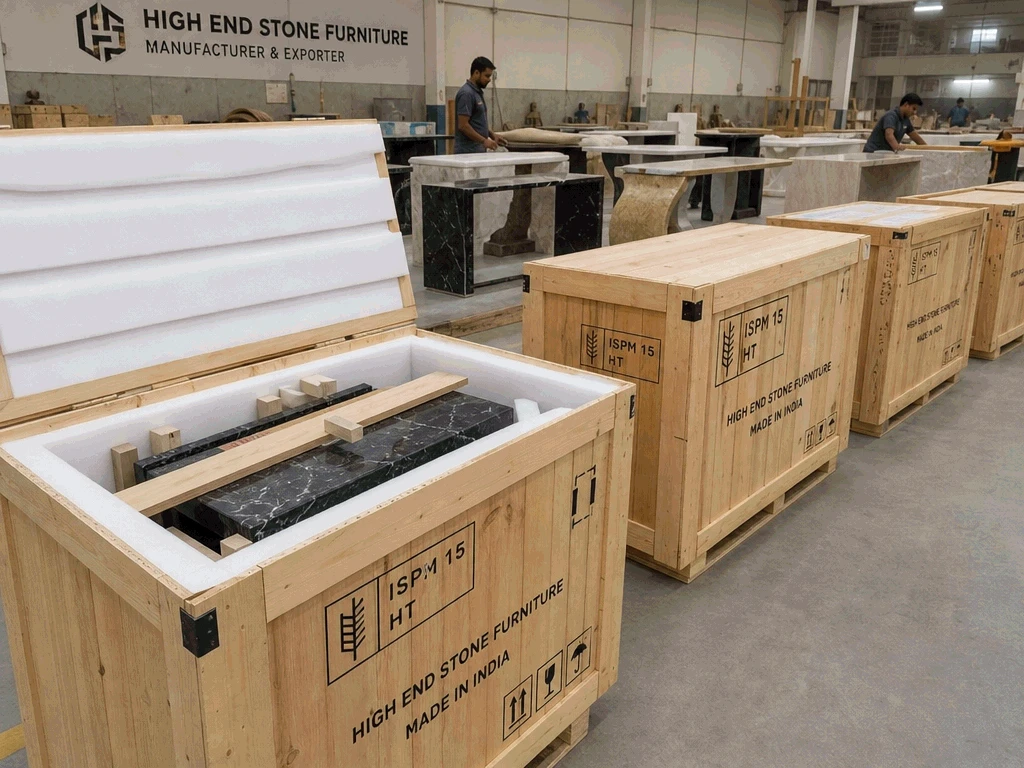
Every solid-wood crate, pallet and dunnage item in an export shipment has to meet ISPM 15, and the two approved treatments are heat treatment to a minimum core temperature of 56 °C held for at least 30 continuous minutes throughout the entire profile of the wood, or fumigation with methyl bromide to the published schedule. Plywood, MDF and particleboard are generally exempt, but any solid-wood crate frame is not. The treatment mark goes on the crate itself, and a certificate without the mark on the wood is not what a border inspector checks.
4.2 Crate design for a stone console
- Foam-face every polished surface, and brace the edges back against the crate wall. A 57 kg console travels as a rigid mass inside a flexible container; the damage comes from the piece moving, not from the crate failing.
- Crate the top and the end panels separately where the joint is dry-fitted at destination. A pre-assembled mitre that has been in a container for six weeks should be checked at the joint before handover, not assumed.
- Build round and curved pieces to a template, not to a rectangle. A curve supported only at its ends is unsupported where it matters.
- Label each piece to its position in the elevation. A numbered kit is assembled in order and a mixed crate is not.
- Weigh and mark each crate. The loading plan depends on the figures, and a substituted figure is what breaks a plan.
Slab bundles fill a container by weight. Crated furniture fills it by volume, and the two behave so differently that a plan built on slab experience will be wrong.
| Loading line | Figure | What it decides |
|---|---|---|
| 20 ft internal volume | About 33 m³ | The binding constraint for crated furniture |
| 20 ft practical payload | 22–25 t | The binding constraint for slab bundles |
| Maximum spread load on a 20 ft floor | 4.8 t per running metre | How the mass has to be distributed along the box |
| 1200 × 400 × 20 mm console, bare | 57.2 kg | 0.36 m³ bounding volume before crating |
| 1500 × 450 × 30 mm console, bare | 107.3 kg | 0.61 m³ bounding volume before crating |
| Crated consoles at 1300 × 500 × 850 mm | About 0.55 m³ per crate | Roughly 40 crates per 20 ft once stacking and frame thickness are allowed for |
| Stone mass in that container | About 2.3 t | Against a 22–25 t payload limit |
A container of marble consoles therefore leaves the yard at roughly a tenth of its payload capacity, because the container runs out of air before it runs out of weight allowance. That single fact drives the commercial conversation: freight per console is set by its bounding volume, so a taller or deeper piece costs more to move even if it weighs the same.
The practical answer is a mixed container. Two 30 mm slab bundles account for about 11 t and roughly half the floor area, leaving about 11 t of headroom and the balance of the cube for furniture crates loaded at the door end, clear of the A-frames. The loading plan is issued per order against the actual piece list, because the crate count changes with the elevation, not with the tonnage. Pieces load FOB Xiamen, China, and the crate count on the packing list is the figure to book the container against.
5. FAQ
Frequently Asked Questions
What is the minimum order for a bulk marble console table programme?
+
-
One piece. There is no container minimum, and mixed orders across furniture, slabs and cut-to-size work are loaded by weight and by crate count in one 20 ft, so a first order does not have to be a full container.
Can stone furniture and slab bundles travel in the same 20 ft container?
+
-
Yes, if the plan starts from the heaviest bundle. Slab bundles in A-frames are loaded fore and aft and crated furniture goes at the door end, clear of the frames. The split is confirmed against the piece list before booking.
What documents ship with a stone furniture order?
+
-
The packing list carries the crate count, the piece mass, the position label for each piece and the ISPM 15 mark on the timber. Two-part adhesive is supplied colour-matched, and piece-specific test data is issued on request.
Start the Order With the Drawing, Not the Price
Send the elevation or the dimensions, the panel thickness, the base depth and the finish, and tell us the floor the piece is standing on and whether it will be fixed to a wall. The drawing comes back as a free CAD dry-lay proposal: vein direction set, joints placed on vein breaks, bookmatched pairs numbered, the base depth checked against the tip-over margin, and the crate count calculated for the loading plan. The stone is cut by a luxury stone furniture factory in China that also cuts and finishes the slabs, so the top and the end panels come from one block rather than from two purchases.