

How to Source Calacatta Gold and Taj Mahal Quartz Slabs with Natural Veining for B2B Projects
Oct 09, 2026
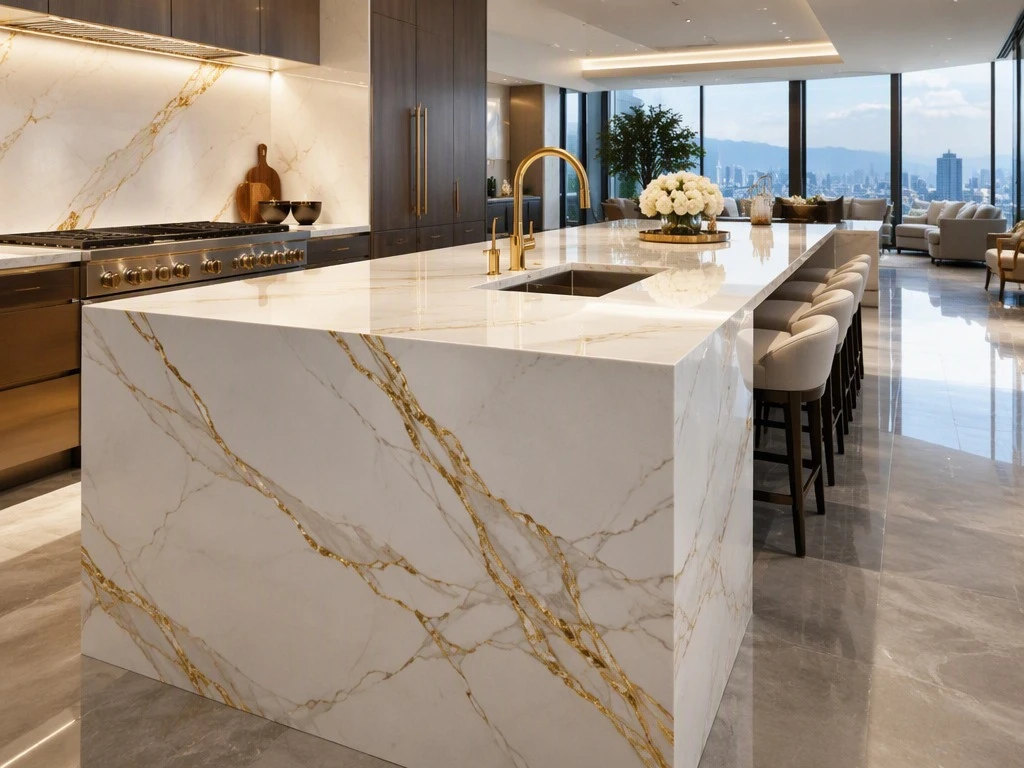
Calacatta Gold and Taj Mahal are trade names for a veining look, not for one material, and in this factory each is quoted against two different products. Both ship as engineered quartz pressed from 90 to 93 percent crystalline quartz with 7 to 10 percent polyester resin, at water absorption below 0.02 percent by ASTM C97 and flexural strength of 45 to 55 MPa by ASTM C170. Both also exist as natural quartzite in the same visual family, at Mohs 7 with 0.05 to 0.30 percent absorption, and that product is quarried rather than pressed, which changes the fabrication schedule, the heat limit and the repeatability of the pattern.
The names describe a look; the material is a separate decision
Engineered quartz: 90 to 93 percent quartz, 7 to 10 percent resin, absorption below 0.02 percent
- Composition is 90 to 93 percent crushed crystalline quartz bound in 7 to 10 percent polyester resin, vacuum vibro-compacted, with pigment and, on a printed pattern, a cured decorative layer.
- Water absorption sits below 0.02 percent by mass to ASTM C97, so a sealer has nothing to fill and no re-sealing programme is sold with it.
- Surface hardness is Mohs 6 to 7 on the composite, against Mohs 7 for the quartz aggregate itself, which is why a kitchen knife does not mark the face and the cut edge is the part that chips.
- The resin binder sets a working surface limit near 120 to 150 °C, so a trivet is part of the specification and not an accessory.
- Standard jumbo format is 3200 x 1600mm at 20mm and 30mm, calibrated to +/-1mm, which is 5.12 m² and about 246 kg per slab at 20mm.
Natural marble: Mohs 3 to 4, sensitive below pH 7, absorption 0.10 to 0.35 percent
- Calcite at Mohs 3 to 4 etches where wine, citrus or cleaning acid stands on it, and no sealer stops the etch, only the stain.
- Absorption of 0.10 to 0.35 percent by mass to ASTM C97 makes sealing a required step before handover rather than an option.
- Compressive strength of 70 to 130 MPa and flexural of 8 to 20 MPa are adequate for a vanity and marginal for a long unsupported countertop span.
- Its veining is unique per block, so a bookmatch is available once and never repeated.
| Property | Engineered veined quartz | Natural quartzite | Natural marble |
|---|---|---|---|
| Composition | 90-93% crystalline quartz, 7-10% polyester resin | Metamorphic, quartz-dominant | Calcite or dolomite |
| Mohs hardness | 6-7 composite, 7 aggregate | 7 | 3-4 |
| Water absorption (ASTM C97) | Below 0.02% | 0.05-0.30% | 0.10-0.35% |
| Compressive strength (ASTM C170) | 190-220 MPa | 150-250 MPa | 70-130 MPa |
| Flexural strength | 45-55 MPa | 15-30 MPa | 8-20 MPa |
| Acid etch | No, inert to kitchen acid | No | Yes, below pH 7 |
| Surface heat limit | 120-150 °C, resin binder | 600 °C plus | Thermal shock risk |
| UV stability | Interior only, ambers | Exterior suitable | Exterior suitable |
| Pattern repeatable | Yes, to Delta E 1.0 per batch | No, unique per block | No, unique per block |
| Sealing required | No | Above 0.10% absorption | Yes |
Why B2B specifiers move to printed and vein-matched slabs
The commercial driver is not the look, since the look has been available in marble for a century. It is repeatability. A hotel that refits a wing three years after handover needs the same slab it installed the first time, and a natural block cannot promise that. A pressed, printed and batch-controlled slab can, and the three controls that make it possible are the print layer, the vein alignment and the colour tolerance.
- A high-resolution print head lays a cured mineral-pigment layer at 1,200 dpi or finer over a base slab, so a single reference block can be reproduced across an entire production run rather than once.
- The printed layer is calibrated at the press rather than at the polishing line, which is why a 3D-printed run holds Delta E 1.0 or better between slabs where a natural run holds nothing.
- Because the pattern is data, a repeat order placed 24 months later is pressed from the retained file, and the retained slab from the original batch is the acceptance reference.
- The trade-off is honest and should be stated to the end client: the pattern is a surface layer, so a sink cutout or a polished edge reveals the base body where a through-body product does not.
- Bookmatch is specified where two mirror-image slabs meet at a mitre or a waterfall return, and the practical tolerance is 1mm of mismatch at the joint line on the printed layer.
- Vein-match is specified where the vein has to run continuously across a joint rather than mirroring, and it requires the two cut pieces to be dry-laid face up and numbered before any edge is polished.
- For a 3,200mm run with a 45 degree mitre, the fabricator needs the bookmatched pair cut consecutively from one bundle, because two bundles of the same colour code will still differ in vein density.
- Dry-lay inspection is the only check that catches a mismatch, and it has to be done before the edge is profiled, since a polished arris cannot be recovered.
- Polished slabs are metered on the delivered face, and the acceptance floor for a veined white is 90 gloss units at 60 degrees, read on the slab rather than on a sample board.
- Batch colour is released against a sealed master, with Delta E 1.0 as the pass mark and a retained slab kept as the working reference for repeat containers.
- Under-cured resin shows as a dull patch that polishing will not lift, and on a white ground metered at 90 gloss units that patch is the most visible defect a slab can carry, so it is rejected at the press rather than at the crate.
- Both looks are graded to the same 90 gloss units and Delta E 1.0 in this factory, and the Calacatta Gold Quartzite Slab and Taj Mahal Quartz Slab pages give the 3200 x 1600mm format, the 20mm and 30mm thicknesses and the payment terms for each.
Request bulk slab and tile pricing against your cut list. Send the cut list, the thickness and the two or three colour references you are comparing, and the reply carries the slab sizes held in your colour, the pieces per bundle, the batch number we will hold for the job and a factory-direct quotation on the volume you are actually buying.
CNC fabrication: undermount sink cutouts and backsplash tolerance
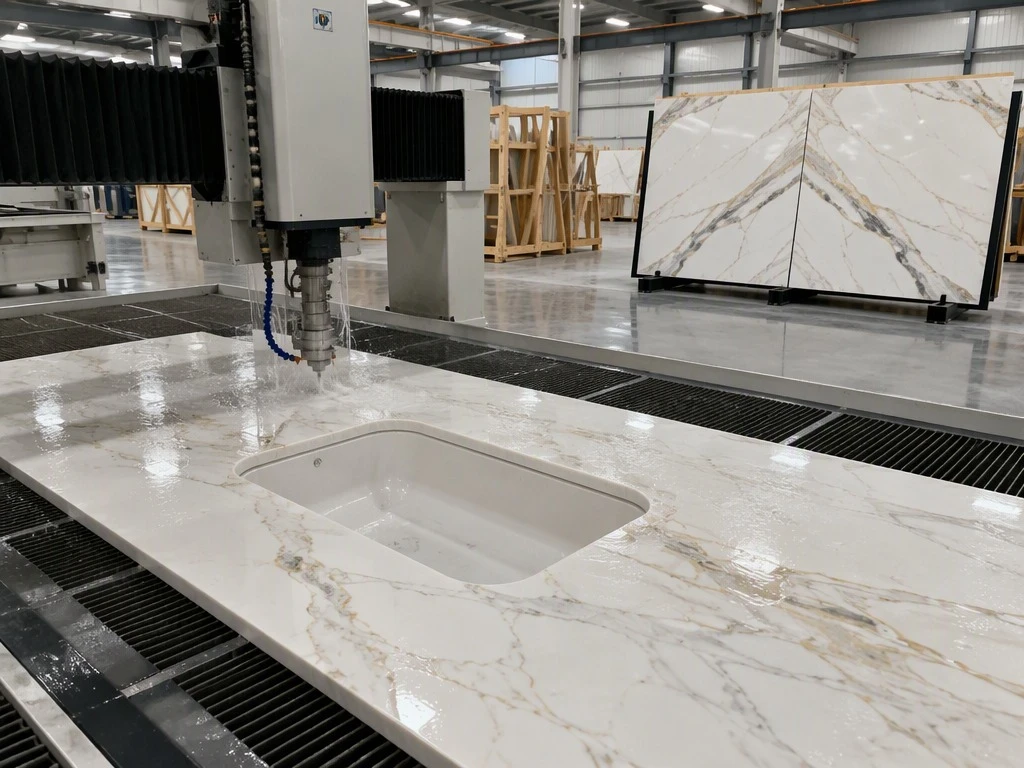
A veined slab is judged on the countertop and lost at the cutout. High quartz content makes a pressed slab hard and brittle in the same piece, so the fabrication schedule matters more than the material on any job with an undermount basin, a hob cut or a long mitred return.
- Sink and hob apertures are cut on a 5-axis waterjet or CNC router from the fabricator's template, held to +/-1mm on the aperture outline and +/-1mm on its position in the top.
- Every internal corner is radiused to a 10mm minimum, because a square internal corner on a brittle high-quartz body concentrates stress and initiates the crack that appears a season later.
- An undermount aperture is laminated and reinforced at the bearing face, since the sink hangs from the stone rather than sitting in it, and a bisected offcut is supplied as the support batten on request.
- Cutting and edge work are done wet or under dust extraction, because dry cutting a slab of 90 to 93 percent quartz releases respirable crystalline silica.
- Upstands are cut at 60mm, 100mm or 150mm to +/-1mm in height, with the mitre held to +/-0.5 degree so the corner closes without a visible wedge.
- A full-height splash of 600mm or more is cut from the same bundle as its countertop, because vein density between two bundles of the same colour code will not match across a joint at eye level.
- The 45 degree mitre at an inside corner is bonded with a colour-matched adhesive rather than a stock cream, which is the difference between a joint and a drawn line on a white slab.
- Tolerances of +/-1mm are stated on the cutting drawing rather than agreed verbally, so a subcontract fabricator works to the same schedule as the factory.
| Operation | Equipment | Tolerance held | Inspection |
|---|---|---|---|
| Slab calibration | Bridge saw and calibrating line | +/-1mm thickness | Four-point gauge per slab |
| Face gloss | Line polisher, 60 degree meter | 90 GU minimum | Metered on the delivered face |
| Undermount cutout | 5-axis waterjet or CNC router | +/-1mm outline, 10mm minimum internal radius | Template overlay before packing |
| Hob and tap cutout | CNC with core drill | +/-0.5mm diameter, +/-1mm position | Gauge on the first piece |
| Backsplash and upstand | CNC saw | +/-1mm height, +/-0.5 degree mitre | Dry-fit against the top |
| Edge profile | CNC profiling head | Arris under 1mm radius | Raking light along the full length |
| Bookmatch alignment | Dry-lay | 1mm maximum mismatch at the joint | Photographed face up |
OEM/ODM colour development for distributor stock programmes
A distributor who sells a colour that every other importer also sells is selling a commodity with a freight bill. The alternative is a proprietary colour developed against a brief and held for that distributor, and it is a programme rather than a purchase order, with defined stages and a sample approval between each one.
- Development opens with a written brief covering the reference look, the target thickness, the finish and the volume the distributor expects to move in 12 months.
- Three 300 x 300mm samples are pressed to the brief and released against the sealed reference at Delta E 1.0 or better, which is the same pass mark used for production.
- Colour, vein density and base tone are approved as three separate Delta E readings on the sample, because a distributor will usually accept a vein change of one step and reject a ground change.
- Nothing is pressed at slab size until the sample is signed, since a slab that fails approval is a 5.12 m² reject rather than a 0.09 m² one.
- A slab trial follows approval, typically three slabs, so the distributor sees the pattern at 3200 x 1600mm rather than at sample scale.
- A test panel is issued with the trial covering absorption to ASTM C97, flexural strength to ASTM C170 and gloss, so the specification can be submitted to a project engineer without a further round.
- Heat behaviour is stated on the panel as a working limit near 120 to 150 °C, because a resin-bound surface is limited by its binder rather than by the stone, and that limit should never be left to a buyer's assumption.
- Trial slabs are packed and shipped as production, so the distributor can place them in a showroom or on a project before committing to a container.
- Every production batch is retained with one sealed slab and its mix record, held for 24 months, which is what makes a repeat order a match rather than an approximation.
- Print files for a proprietary colour are held for 24 months against the distributor's code, and are not released to another buyer while the programme is current.
- An alternative palette is usually the safest route to a first 20ft programme for a new distributor, and the Calacatta Victoria Quartz and Calacatta Nuvo Slab pages show two colours already developed in this range that can be rebadged and held.
- Where a distributor wants a natural alternative on the same shelf, the Super White Quartzite Slabs page covers the quarried option at Mohs 7, which cannot be held to a batch but can be reserved as a block lot.
| Stage | Duration | Deliverable | Approval gate |
|---|---|---|---|
| Written brief | 2-3 days | Look reference, thickness, finish, 12-month volume | Confirmed in writing |
| Sample press | 10-15 days | Three 300 x 300mm samples | Delta E 1.0 or better |
| Colour approval | 5 days | Sealed master retained at the factory | Signed sample returned |
| Slab trial | 20-25 days | Three 3200 x 1600mm slabs plus test panel | ASTM C97 and C170 panel accepted |
| Production | 25-30 days | Container per the agreed bundle count | Batch slab sealed and retained 24 months |
Get a free CAD dry-lay proposal before you commit a container. Send the elevation or the cut list and the colour reference, and the drawing comes back with the vein direction set, the joints placed on vein breaks, the bookmatched pairs numbered and the bundle count calculated, so the fabrication schedule and the loading plan are agreed at the same time as the price.
Packing and container loading
Slabs are the one product where the packing is the transport, since a bundle that has not been braced correctly arrives as breakage whatever the material cost. The figures below are the ones to quote against when a distributor is working out landed cost per square metre.
- A 3200 x 1600mm slab at 20mm weighs about 246 kg and covers 5.12 m², so a 15-slab bundle is about 3.7 tonnes and about 77 m².
- A 20ft container takes roughly six or seven bundles in A-frames before it reaches a payload of about 22 to 25 tonnes, which is about 100 slabs and roughly 510 m².
- Weight, not volume, is the constraint at 20mm, so a mixed order is loaded by bundle weight rather than by slab count.
- The same slab at 30mm weighs about 369 kg, so a 15-slab bundle is about 5.5 tonnes and about 77 m².
- A 20ft therefore carries about four bundles, roughly 60 slabs and about 307 m², and the container is full on weight well before it is full on space.
- Thickness mixing within one 20ft is possible but the plan has to start from the heaviest bundle of 5.5 tonnes, so the payload is not exceeded at the door.
- Bundles are stood vertically in A-frames with the polished faces filmed and corner protectors fitted, and the timber is fumigated to ISPM 15, with the mark applied to the crate rather than to a separate certificate alone.
- Each bundle is banded against movement, and the batch number, the 15-slab count and the gloss reading travel on the packing list, so a consignment can be checked against the retained slab on arrival.
- Slabs are never stacked flat, because a flat stack transfers the 246 kg of each upper slab through the middle of the bottom one, and that is where the breakage happens.
- Where a mixed order includes finished work, the catalogue of 20mm and 30mm formats is on the Quartz Slab page, and the wider range including composite and marble-look products is on the Artificial Quartz Slabs page.
| Bundle and load | 20mm | 30mm |
|---|---|---|
| Slab size and area | 3200 x 1600mm, 5.12 m² | 3200 x 1600mm, 5.12 m² |
| Weight per slab | 246 kg | 369 kg |
| Slabs per bundle | 15, about 77 m² | 15, about 77 m² |
| Weight per bundle | 3.7 t | 5.5 t |
| Bundles per 20ft | 6 to 7 | 4 |
| Slabs per 20ft | About 100, roughly 510 m² | About 60, roughly 307 m² |
| Loaded payload | 22 to 25 t | 22 t |
| Binding constraint | Payload weight | Payload weight |
FAQ
Frequently Asked Questions
What is the minimum order for Calacatta Gold or Taj Mahal quartz slabs?
+
-
One bundle, which is 15 slabs of 3200 x 1600mm, about 77 m². Mixed colours and mixed thicknesses can be combined in one 20ft container where the payload allows, so a first order does not have to be a full container.
Can you mix colours, thicknesses and finished work in one container?
+
-
Yes. Bundles are loaded by weight, so a 20mm and a 30mm colour can share a 20ft if the plan starts with the heaviest bundle. Cut-to-size pieces are crated separately and marked by room or elevation.
How long does a waterjet cut-to-size order take, and what documents ship with it?
+
-
Cut-to-size runs 25 to 30 days after drawing approval, against 10 to 15 days for plain slabs. The crate ships with the ISPM 15 fumigation mark, the packing list carrying the batch number and slab count, and the test panel on request.


