

Artificial Quartz vs Engineered Marble: Which Is Better for Commercial Countertops and Windowsills
Sep 29, 2026
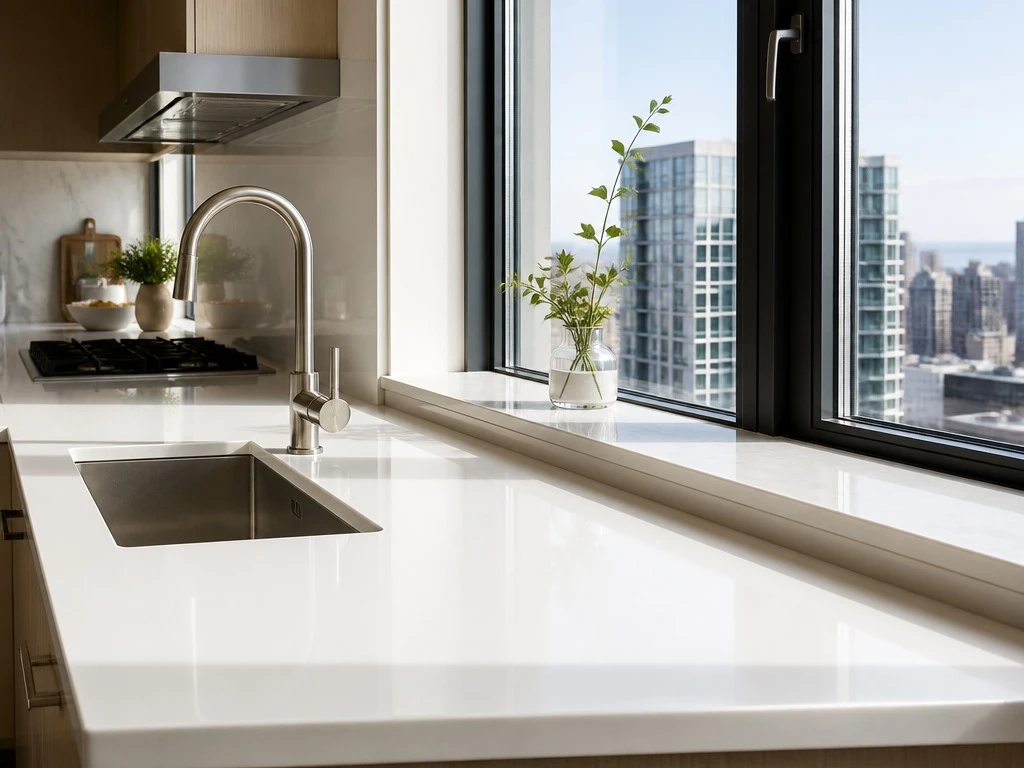
Artificial quartz and engineered marble are both resin-bonded stones, and the ratio between filler and binder decides which one a project should buy. Quartz surfacing runs 90 to 93% crystalline quartz with 7 to 10% polyester resin and wins on scratch, stain and abrasion resistance; engineered marble runs a higher resin fraction over marble powder or alumina trihydrate and wins on heat tolerance, on-site repairability and cost per square metre. Neither belongs on an uncovered exterior sill, and both need a trivet under a hot pan.
1. What separates the two materials: filler fraction, not the trade name
Both products are agglomerated stone in the European classification, which is the term to use when a specifier asks what the material actually is. The trade names are unreliable: "quartz" and "engineered marble" describe the filler system, not the binder, and the binder is what fails first on site.
| Parameter | Artificial quartz | Engineered marble (resin-bonded) |
|---|---|---|
| Filler system | 90-93% crystalline quartz aggregate, graded 0.1-3 mm | 70-80% marble powder, dolomite or alumina trihydrate (ATH) |
| Binder fraction | 7-10% unsaturated polyester resin | 20-30% polyester or acrylic resin |
| Classification standard | EN 14618, agglomerated stone terminology and classification | EN 14618, same family |
| Slab formats | 3200x1600 mm and 3000x1400 mm, 15-30 mm | 2440x1220 mm and 3050x1240 mm, 12-20 mm |
| Density | 2.35-2.45 g/cm3 (quartz aggregate is heavy) | 1.80-2.50 g/cm3, moving with the filler: ATH is light, marble powder is heavy |
| Typical use in a commercial package | Kitchen and vanity tops, high-traffic horizontal work | Wall linings, window boards, skirts, vanities with heavy templating |
- Polyester binder softens in the 120-150 °C band, so a pan taken off a hob at 200 °C or more can leave a burn ring or shock-crack an artificial quartz top. Trivet use is a specification item, not a house rule.
- ATH filler gives up bound water above roughly 180-220 °C, which is why engineered marble holds a better reaction-to-fire classification; the grade is declared under EN 13501-1 and, for US projects, ASTM E84 Class A or B.
- A melting point quoted for silica, around 1710 °C, is not a service temperature for a resin-bonded composite, and no agglomerated slab should be used unshielded against flame.
- Residual styrene monomer is the volatile of concern in polyester-bonded stone, and full post-cure is the control: an under-cured slab measures high under EN 16516 or ISO 16000-9 chamber tests and reads as odour in a sealed lift lobby.
- Low-emission programmes quote thresholds against CDPH Standard Method v1.2 (Section 01350) or GREENGUARD Gold, both of which are chamber tests, not material certificates.
- Filler choice matters here as well: ATH is an inorganic hydrate with no solvent fraction, so an engineered marble wall lining usually clears an EN 16516 chamber test with less formulation work than a deeply pigmented quartz.
2. Physical properties compared, with the test codes that a specifier will ask for
The table below is the one to put in front of a project engineer. Values are ranges for commercial production, not a single benchmark, and each line names the method used.
| Parameter | Artificial quartz | Engineered marble | Test method |
|---|---|---|---|
| Water absorption | 0.02-0.05% | 0.10-0.30% | ASTM C97 |
| Flexural strength | 45-60 MPa | 35-50 MPa | EN 14617-2, ASTM C880 |
| Compressive strength | 180-220 MPa | 100-160 MPa | ASTM C170 |
| Surface hardness | Mohs 6-7, aggregate-driven | Mohs 3-4, filler-driven | Field scratch and Taber |
| Abrasion resistance | High HA value, suitable for public counters | Lower HA value, needs a mat or a protective zone | ASTM C1353 |
| Heat tolerance | Binder limited, trivet mandatory | Better than quartz, still marks under sustained heat | EN 13501-1 reaction to fire |
| On-site re-sanding | Not viable: sanding removes the factory finish and exposes aggregate | Viable: wet-sand through grits and buff back to sheen | Manufacturer procedure |
| UV and exterior exposure | Resin yellows under direct sun over years | Resin yellows faster and ATH chalk appears | ISO 4892-2 xenon-arc |
| Acid and stain | Resistant to household acids and alkalis | Moderate: calcite filler is acid sensitive | EN 14617 chemical resistance series |
| Chip repair | Matched resin; the repair stays visible in a glance | Sanded and blended; usually invisible | Site procedure |
| Dimensional standard for tops | EN 15388, slabs and cut-to-size for vanity and kitchen tops | EN 15388, same scope | EN 15388 |
| Dimensional standard for walls | EN 15286, slabs and tiles for wall finishes | EN 15286, same scope | EN 15286 |
Bottom line for procurement: buy artificial quartz where the surface is abused, buy engineered marble where the surface is shaped, cut and heat-exposed, and buy neither for an exposed facade. For bulk slab programmes there are wholesale artificial quartz slabs and engineered marble manufacturer categories on the factory side, both cut on the same lines.
3. Prefabricated countertops: the arithmetic that decides a project budget
The material choice saves a few percent. The fabrication route saves weeks and a fabricator's day rate, and on apartment and hotel packages that is where the real number sits.
| Cost and programme driver | Bulk slab, fabricated on site | Prefabricated to drawing at the factory |
|---|---|---|
| Cutting, edge profiling and cutouts | 4-6 fabricator-hours per kitchen run, plus a second visit for cutouts | Zero on site; edges and cutouts finished before packing |
| Templating | Site template, two visits, cabinet level must be fixed first | One template or CAD drawing, approved against a dry-lay photograph |
| Offcut loss | 8-12% of slab area carried by the project | Nesting done at the factory; loss stays with the stone, not the building |
| Programme risk | Stone on site before the cabinets are level | Dimensions frozen in CAD before the blade goes in |
| Freight basis | Slab weight in A-frame crates, about 246 kg for a 3200x1600x20 mm slab | Finished-piece weight in flat crates, about 76 kg for a 2440x650x20 mm top |
| Site sequence | Fabrication follows installation | Factory cutting runs in parallel with site works |
- Non-rectangular work with in-situ radius checks (spiral stair strings, curved bar fronts) still needs site templating, because a 3 mm error in a curved wall reads as a 10 mm gap at the panel edge.
- Very long runs over 3200 mm force a joint, and the joint must be planned on the drawing: book-match and vein-match pairs are cut from adjacent slabs and numbered, or the seam lands in the middle of a sightline.
- A mixed package of tops, splashbacks and window boards should be nested together: cutting the boards out of the same slab as the tops holds the shade and the batch number, and keeping the nest inside a 3200 mm slab length is what stops a run needing a second joint.
- For exterior sills the quarry direct route is granite rather than either composite, cut from the group's own G603, G654, G682 and Shanxi Black quarries instead of being bought in.
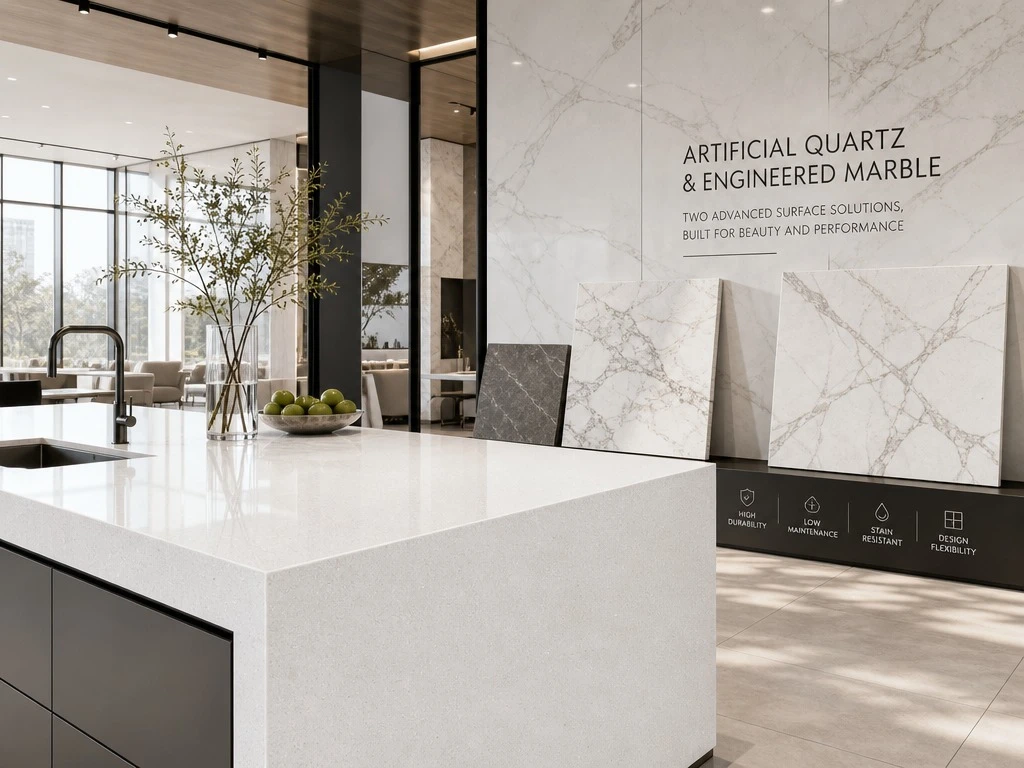
4. Windowsills and bathroom skirts: the exposure decides the material, not the price
Window boards are the one place where the two products diverge sharply, because a sill sits in solar gain, against masonry, and often in a bathroom where it is wet for part of the day.
| Application | Artificial quartz | Engineered marble | Quartzite or natural marble | Granite |
|---|---|---|---|---|
| Interior window board, north elevation | Yes, 0.02% absorption, no sealing | Yes, wet-sandable after site damage | Yes, at 20 mm with a drip groove | Yes, heavier for the same span |
| Interior window board, south elevation | Resin can yellow over years under direct sun | Yellows faster; specify a UV-stable grade | Preferred: quartzite is UV-stable and hard | Preferred where the span is long |
| Exterior sill, exposed | Not advised, resin yellows and chalking appears | Not advised, ISO 4892-2 exposure shows it early | Quartzite at 30 mm, 5 mm drip groove, flamed, honed or bush-hammered face | The default exterior answer, and the quarry direct one |
| Bathroom skirt and splash apron | Yes, 20 mm with a bullnose or eased edge | Yes, mitres read as one piece at 20 mm | Yes, sealed at 0.2-0.5% absorption ceiling | Yes |
| Shower wall and niche lining | Yes, in slab to keep joints out of the wet zone | Yes, but check the acid resistance of the filler | Yes | Yes |
| Windowsill in a commercial kitchen or lab | Yes, ASTM C1353 abrasion suits a high-traffic bearing edge | Limited; the calcite filler stains with acids | Yes | Yes |
- Sill depth under 200 mm leaves no room for a drip groove, and a sill without a groove streaks the facade below it regardless of which stone is used.
- A bathroom skirt bedded wet against a wall has no movement gap; a 2 mm back-gap and a flexible sealant matter more at 20 mm thickness than the choice between quartz and engineered marble, because both expand with heat.
5. Fabrication quality control at Shuitou and Yunfu: fire classification and VOC
Our kitchen and vanity work is fabricated by the Shuitou and Yunfu teams working under the export desk of our Xiamen stone factory, so as a China manufacturer and stone supplier running wholesale programmes the documents below are generated in the workshops rather than copied from a template.
- Batch resin dosing is logged per press run, because flexural strength under EN 14617-2 moves with the binder fraction, and a 1% drift in resin changes a 55 MPa result.
- Full post-cure is recorded as a time and temperature trace, the control that keeps residual styrene inside an EN 16516 chamber limit.
- Reaction to fire is tested on the formulation under EN 13501-1, not on a competitor's datasheet, and the report is filed against the decor rather than the product family.
- Dimensional checks follow EN 14617-16 for tiles and the application standards EN 15286 for wall products and EN 15388 for kitchen and vanity tops.
- Where a project needs CE marking, the route is the harmonised product standard and a Declaration of Performance, with EN 14617 used for the test methods behind it.
- Factory audit packs are kept current: ISO 9001 quality system, fumigation and heat-treatment records under ISPM 15, and photographs of the dry-laid lot before crating.
6. Container loading and mixed-load planning for a 20 ft
Quartz and engineered marble both load by weight before they load by volume, so a mixed container is planned as a weight budget. The example below is a real planning sheet for one 20 ft, using 3200x1600x20 mm and 2440x1220x12 mm formats.
| Line | Product | Size (mm) | Pieces | Unit weight | Line weight |
|---|---|---|---|---|---|
| 1 | Artificial quartz slabs, 20 mm, polished | 3200x1600 | 24 | 246 kg | 5.9 t |
| 2 | Engineered marble slabs, 12 mm | 2440x1220 | 40 | 88 kg | 3.5 t |
| 3 | Prefabricated quartz countertops, 20 mm | 2440x650 | 60 | 76 kg | 4.6 t |
| 4 | Artificial marble windowsills, 20 mm | 1500x300 | 200 | 22 kg | 4.4 t |
| Total | Four lines, four applications | 324 | 18.4 t | ||
| Ceiling | 20 ft planning payload | 22.0 t | |||
| Headroom | Crating, dunnage and corner protection | 3.6 t |
Loading rules that follow from that arithmetic:
- Slabs travel upright in A-frame bundles with foam and corner protection, 10 to 12 slabs per bundle at 20 mm; finished tops travel flat and stacked by size so nothing bears on a bullnose edge.
- Crates are fumigated or heat-treated and stamped under ISPM 15, and the loading diagram is issued with the packing list before the doors close.
- Book-match pairs cut from adjacent slabs are numbered on the slab edge and on the packing list, so a mirrored 3200 mm run stays in sequence when the crates are opened on site.
7. Questions a wholesale buyer asks before the first container
What is the minimum order quantity for wholesale artificial quartz slabs and engineered marble pieces?
One crate as a trial, then a mixed 20 ft as the working minimum. A 20 ft of 20 mm quartz slabs runs about 88 to 92 jumbo slabs at a 22 t planning payload, and small engineered marble quantities can be consolidated onto the same container.
Can quartz slabs and engineered marble windowsills be mixed in one 20 ft container?
Yes, and it is the usual way to fill a first order. The four-line example above comes to 18.4 t against a 22 t ceiling, which leaves 3.6 t for crating and dunnage. Each line is crated and labelled separately for customs.
How long does CNC waterjet fabrication take, and what packing certificates ship with it?
Allow 10-15 days for a 20 ft of jumbo slabs and 15-20 days where waterjet shapes or mitred edges are involved. Packing ships with an ISPM 15 fumigation or heat-treatment stamp, a packing list, and the dry-lay photographs.
Get a bulk quote with the cutting plan attached


