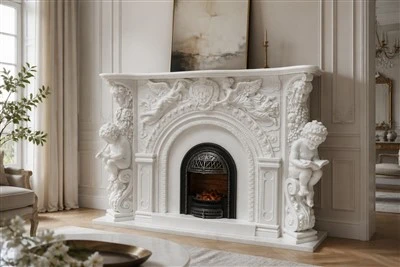
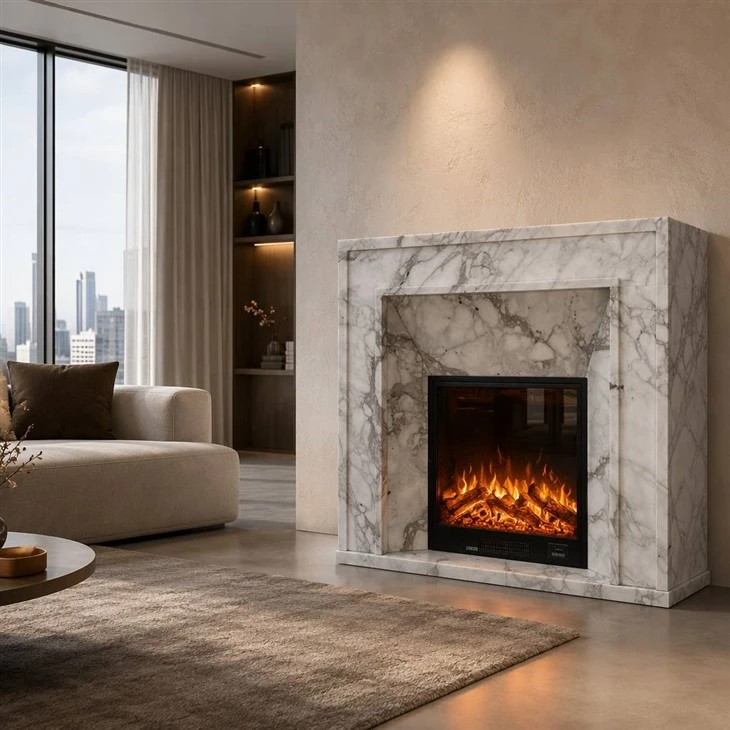

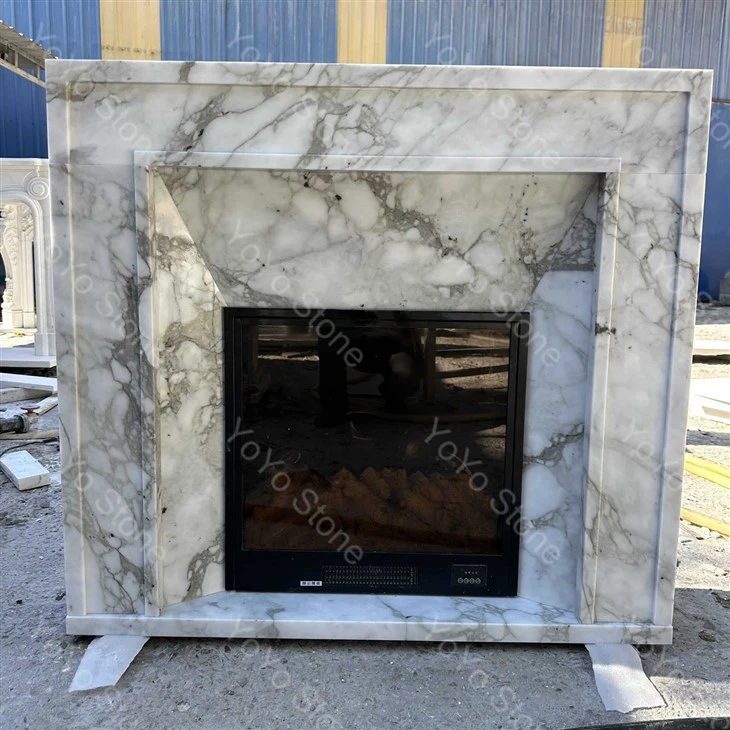
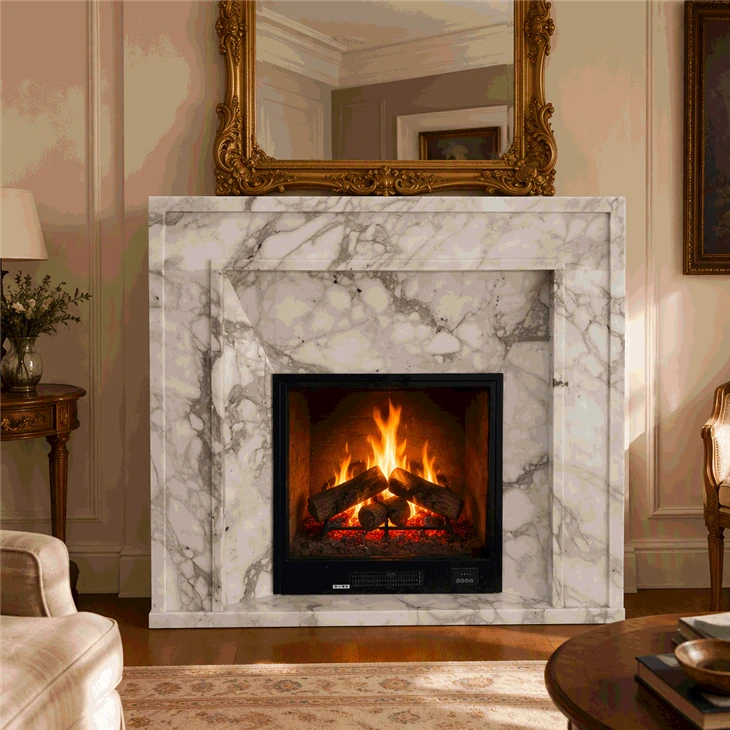
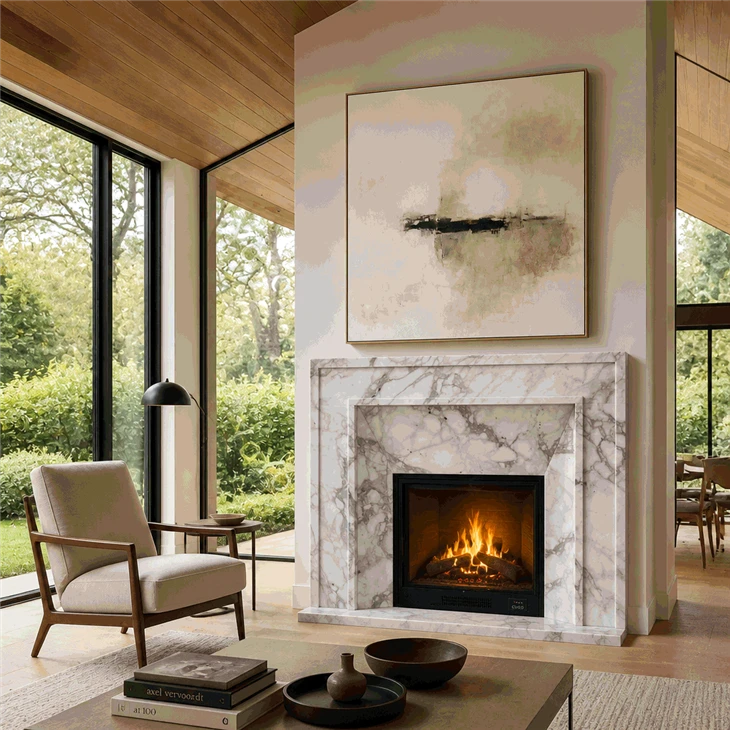
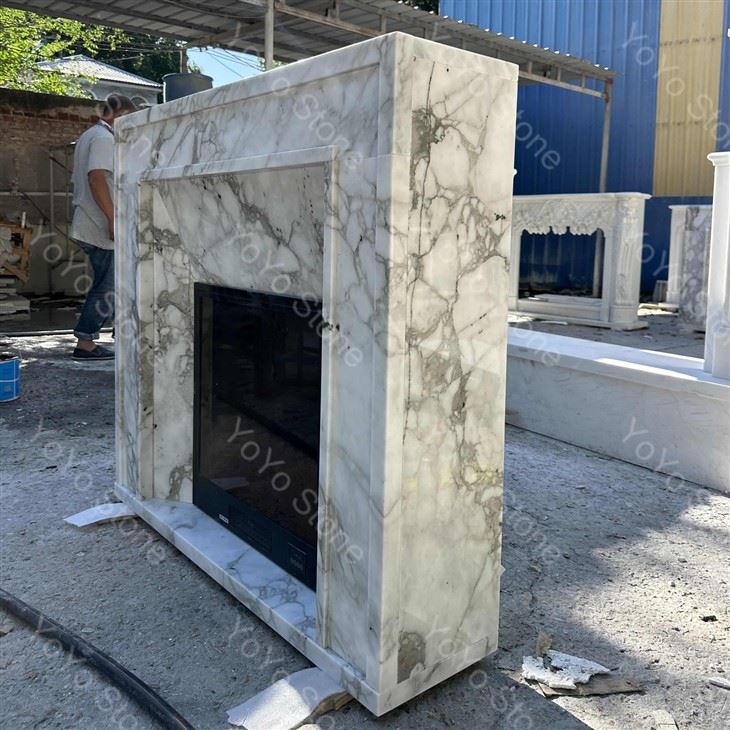
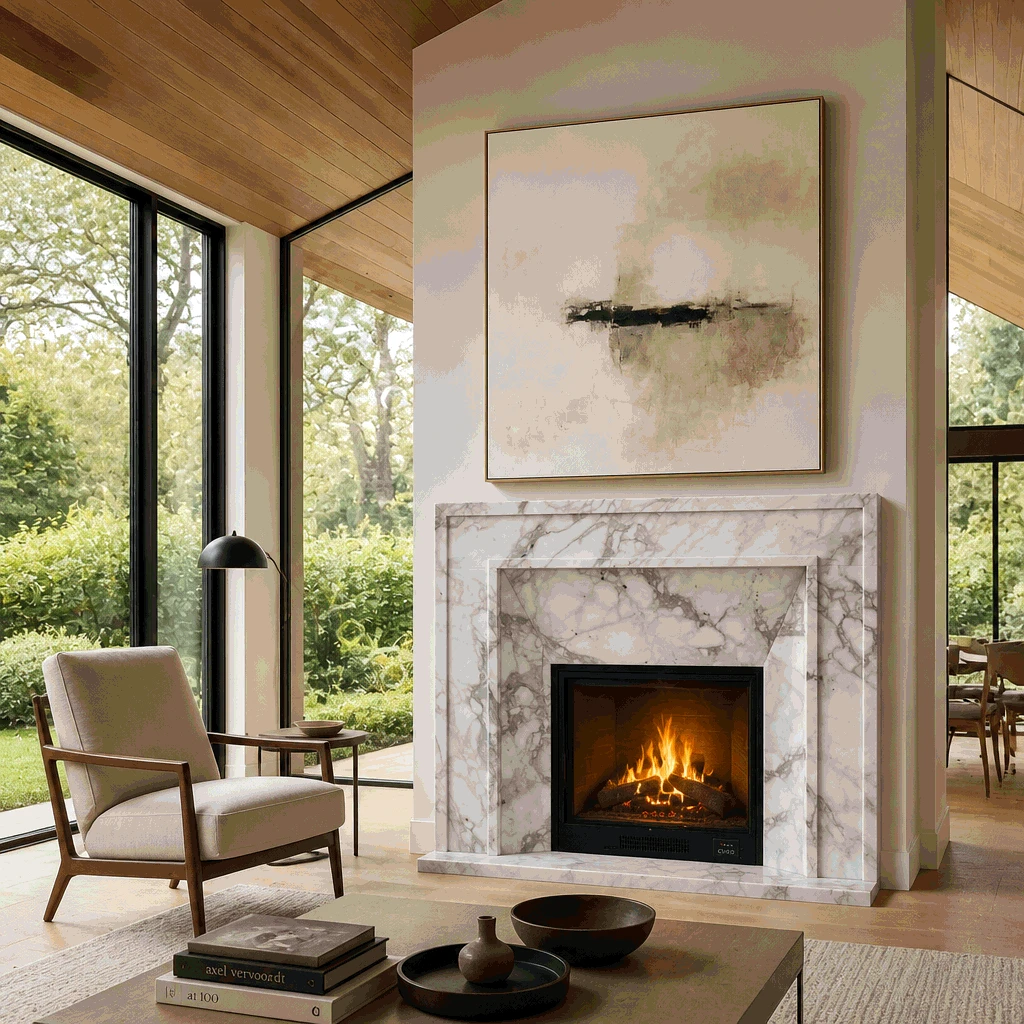
Calacatta Marble Fireplace
Color: White; ivory; violet veined
Size: To your insert cut-out drawing
Finished: Polished, honed
Application: Lobbies, villas, apartments
Low MOQ: One set; free sample
- Fast Delievery
- Quality Assurance
- 24/7 Customer Service
Product Introduction
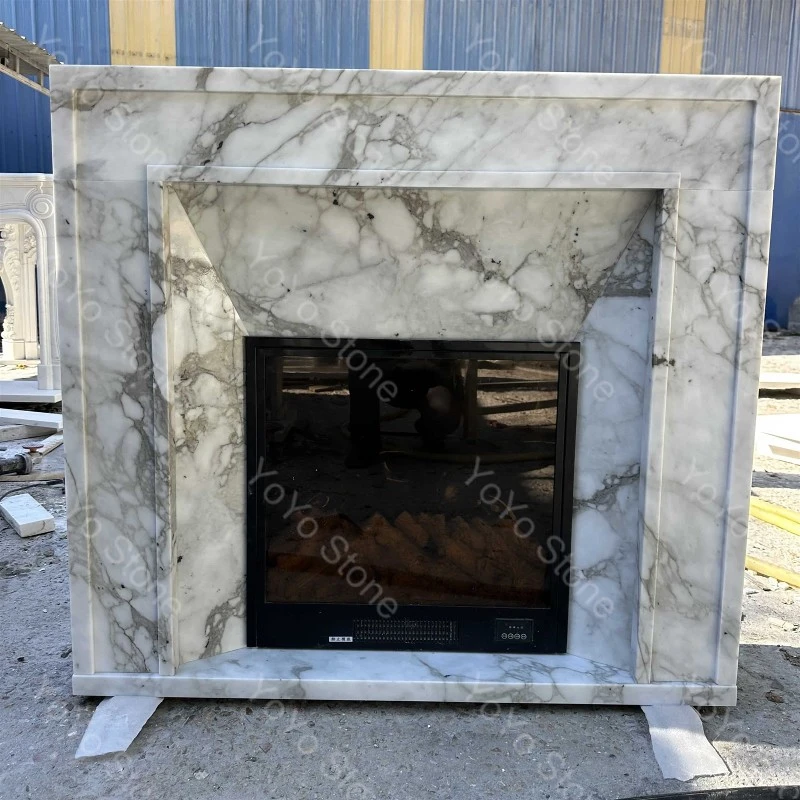
A Calacatta marble fireplace is a facing, not a fireplace. What leaves the workshop is four pieces of solid stone - two legs, a frieze and a mantel shelf, with a hearth slab in front - shaped to stand around an opening that a firebox or an insert occupies. Nothing cut for a surround belongs inside the combustion chamber. That surface is lined with refractory firebrick by whoever supplies the fire, and a marble assembly asked to do that job instead will not see out a season.
Two names sit on this page and they are not the same stone. Calacatta carries a white ground with grey or gold veining. Calacatta Viola carries an ivory to white ground with violet, plum and burgundy veining, and it travels in the trade under the name Bulgari, which is a marketing label attached by different yards to different blocks rather than the name of a quarry or a grade. Both are calcitic marble from the Carrara district in Tuscany, and both are sold as a look, so the sensible way to write an order is against the figure you have been shown, with the block it came from named on the packing list.
Products Description
| Parameter | Specification |
|---|---|
| Product and Configuration | Two legs, a frieze, a mantel shelf and a hearth slab, cut from solid marble and assembled around an existing opening. Deeper returns, corner blocks and an overmantel panel are cut and supplied with the set where the wall calls for them |
| Stone Type and Origin | Calacatta and Calacatta Viola calcitic marble from the Carrara district in Tuscany, Italy, in block or slab form. Composite quartz and Chinese white marble are quoted only when a project asks for them by name, and never ship under a Calacatta description |
| Stone Colour and Figure | Calacatta runs a white ground with grey or gold veining; Calacatta Viola runs ivory to white with violet, plum and burgundy veining. Viola is also sold as Bulgari, a trade label applied inconsistently between yards, so orders are written on the figure rather than on the label |
| Standard Sizes | Openings from 600 to 1500 mm wide and 600 to 1200 mm high; overall surround widths from 900 to 2000 mm; shelf set 1350 to 1550 mm above finished floor, the 54 to 60 inch band most residential rooms are drawn around |
| Opening and Insert Fit | Cut to the insert maker's cut-out drawing with a 2 to 3 mm working allowance closed by the bevel return. Where no drawing exists, we work from the opening measured on site with a diagonal check across both pairs of corners |
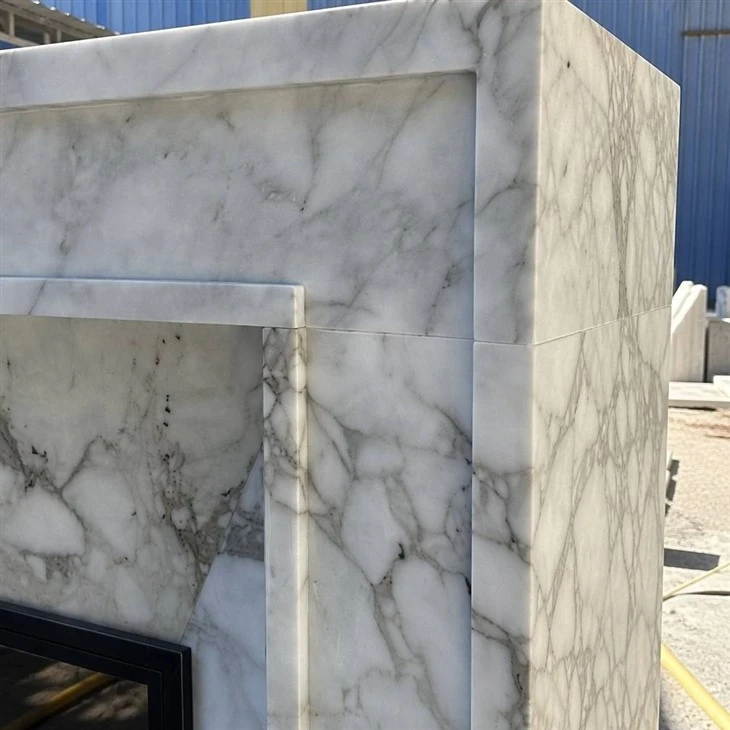
| Mantel Shelf and Profile | Shelf projection 40 to 100 mm, square or moulded edge. Shelf and frieze come off one block wherever the depth allows, so the figure carries across the face without a break at the joint |
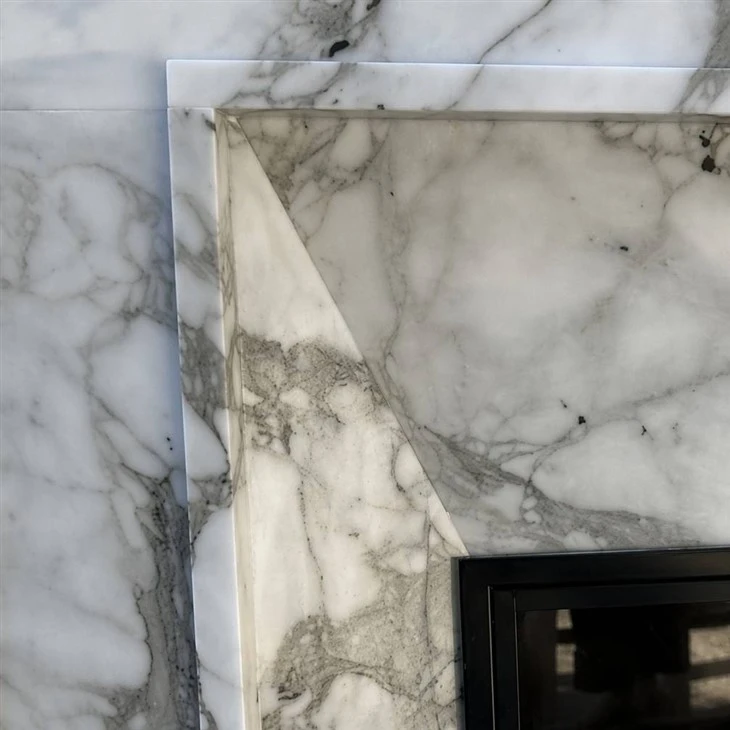
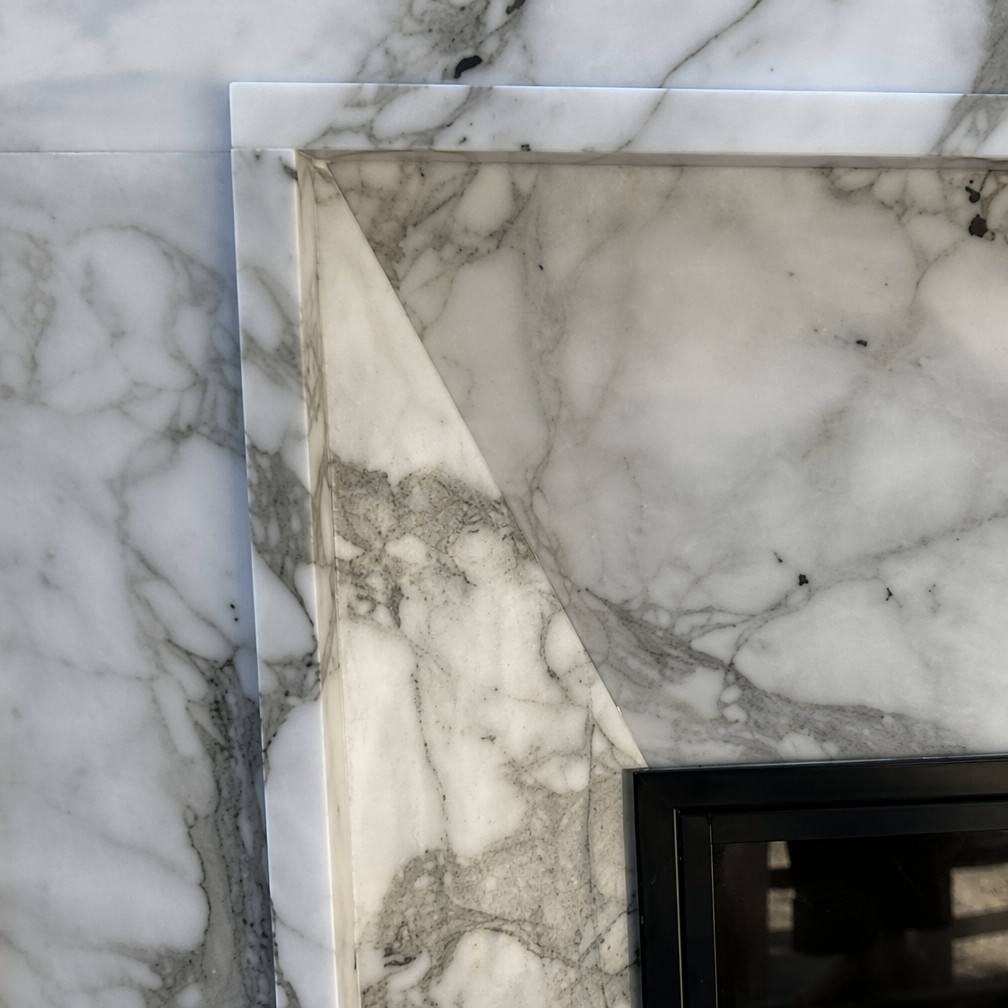
| Inverted Bevel Detail | The inner edge is taken back toward the wall rather than forward into the room, so the frame reads thinner at the opening and the shadow line falls under the shelf. Because material is removed from the back of that edge, the section left at the opening is measured and stated |
| Hearth Extension | Front projection 406 mm (16 in) and 203 mm (8 in) to each side as standard for an opening under 0.56 m² (6 sq ft); 508 mm and 305 mm where the opening is larger. Thickness 20, 30 or 40 mm |
| Clearance to Combustibles | Minimum 150 mm (6 in) from the opening to combustible trim, widened by 25 mm for every 3 mm the trim projects past the wall face. Where the insert manual asks for more than this, the manual governs |
| Substrate and Fixing | Minimum 12 mm cementitious backer board over the framing rather than paper-faced board; panels carried on stainless or brass ties set into the studs as well as bedded, because adhesive on its own releases once the substrate starts cycling |
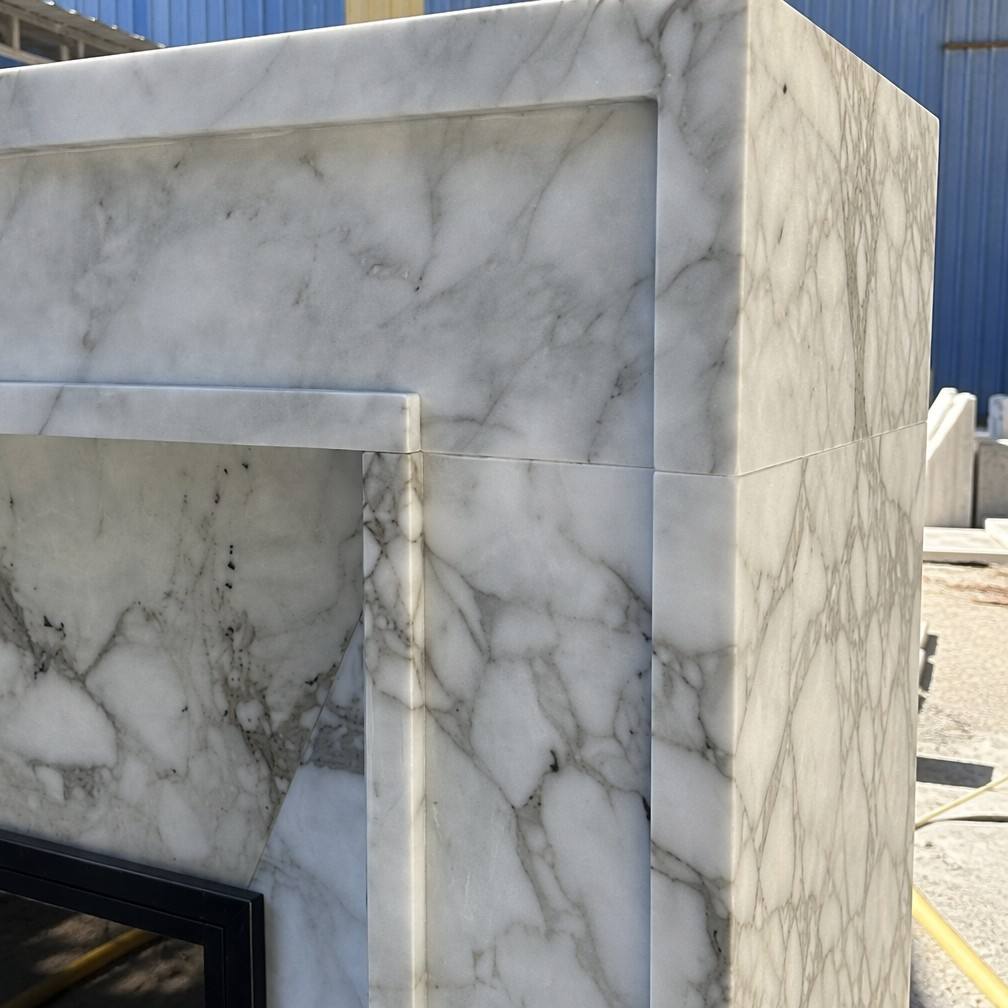
| Bedding and Seams | Backs fully buttered and tapped for hollow notes before bedding. Panels book-matched on the centre line of the chimney breast with the seam held clear of the opening zone, and any seam that has to cross the heat zone dry-bedded and pinned as well as bonded |
| Surface Finishes | Polished or honed as standard. The edge of the opening is always honed even where the face is polished, so the arris that would chip first comes off before the frame leaves the workshop |
| Tolerances | Opening held to ±1 mm on the drawn size; shelf level within ±0.5 mm along its length; joint faces flat to a feeler gauge before bedding; thickness ±1 mm |
| Bulk Density | Around 2.71 g/cm³, the figure for the calcite these marbles are made of, against 2.65 to 2.80 g/cm³ for the granites we supply. A cantilevered shelf is sized on the lot figure rather than on this line |
| Water Absorption | 0.10 to 0.35 percent by mass to ASTM C97 / EN 13755, which is why sealing is a scheduled step before handover rather than an option, and why soot and spills are wiped while wet instead of being left to draw in |
| Compressive Strength | 70 to 130 MPa to ASTM C170 / EN 1926, which is ample for a surround carrying its own weight on a level substrate |
| Flexural Strength | 8 to 20 MPa to ASTM C99 / EN 12372, and this is the figure that governs how far a shelf may project unsupported and how thin a leg may be cut before it needs a wider bearing |
| Heat Limit and the Firebox | Marble reads as non-combustible under NFPA 211 and the IRC, but it is calcitic: sustained contact above roughly 150 to 200 °C and rapid cycling at the opening edge open existing fissure lines and can spall the face. The combustion chamber stays lined with certified refractory firebrick |
| Acid, Soot and Sealing | Calcite sits at Mohs 3 to 4, so wine, citrus juice and acid cleaning products mark the surface, and sealing holds the stain back rather than the etch. A breathable penetrating impregnator goes on before first use, soot is wiped with a neutral pH stone soap, and a stubborn mark is poulticked instead of scrubbed |
| Packing, Port, MOQ and Lead Time | Legs, frieze, shelf and hearth crated separately in fumigated ISPM 15 timber, foam faced, edges braced back against the crate wall, each piece labelled to its position in the elevation; FOB Xiamen, China; one set minimum; around 31 days for a first set of one to five pieces, and quoted against the drawing above that |
Products Inspection
Quality Control & Inspection Standards
Standoff Line Struck First
Every set is laid out against the insert maker's clearance drawing, and the standoff line is struck on the wall before a cutting ticket is written.Stone is then cut to that line rather than the line being moved to suit the stone, so a panel that arrives a few millimetres long is trimmed at the wall instead of the fireplace being asked to shift.
Backs Read By Tap
Before bedding, the back of each panel is buttered and tapped with a mallet, listening for the hollow note that means the mortar has not reached the edge.
Seam Kept Off Opening
Book-matched panels meet on the centre line of the chimney breast, and that seam is held out of the band immediately above and beside the opening, where the surface swings hardest between hot and cold.
Bevel Cut Keeps Section
An inverted bevel is the profile that carries the most risk in this assembly, because the stone it leaves thinnest sits at the edge where the temperature moves fastest.
Products Application
Typical Project & Application Scenarios

Hotel Lobbies and Reception Walls
A reception wall is where a veined stone earns its freight, because the surround is usually the only element in the room that is read from close up and from across the lobby in the same minute. That double distance is what makes book-matching worth specifying: the seam on the centre line of the chimney breast reads as one continuous figure from the entrance, while the figure at the opening reads as a deliberate frame from three metres away.
Where the fireplace runs daily, the order is normally cut honed rather than polished, which keeps fine soot marks and the micro-crazing that heat eventually brings from showing against the light. Where several rooms carry the same elevation, the pieces for those rooms are cut from a single block wherever the opening dimensions let them, so a guest does not walk past two different whites in one corridor.
Villas, Model Homes and Show Flats
A private house or a show flat is judged on the drawing rather than on the material list, so the surround is usually the first piece of the order to be agreed and the last to be released. The useful thing to send early is the insert model, because the clearance figure in its manual fixes the geometry of the frame before anything else can be settled, and changing the insert after the stone is cut is the most expensive change available.
Where the room is being photographed, a polished face returns the firelight and the room lighting in a way a honed face does not, and a shelf set near 1500 mm reads with a better proportion than the floor-level heights that look correct on a plan. Show flats are usually ordered with a spare frieze, because a model home is moved on and the piece damaged in the move is nearly always the frieze.
FAQ

Frequently Asked Questions (FAQ)
What is the difference between Calacatta and Calacatta Viola?
Calacatta has a white ground with grey or gold veining. Calacatta Viola has an ivory to white ground with violet, plum and burgundy veining, and is also sold as Bulgari. Both are calcitic marble from the Carrara district, so the same heat and sealing rules apply to either one.
How much clearance does a marble fireplace surround need?
Allow at least 150 mm from the opening to combustible trim, widened by 25 mm for every 3 mm the trim projects. The hearth runs 406 mm in front and 203 mm to each side for an opening under 0.56 m². Where the insert manual asks for more, it governs.
Can marble be used inside the firebox?
No. Marble is non-combustible but it is calcite, and sustained contact above roughly 150 to 200 °C, or rapid cycling at the opening edge, opens existing fissure lines and can spall the face. The combustion chamber stays lined with certified refractory firebrick, and the marble stays the facing.
Should a marble surround be honed or polished?
Both are structurally sound, so the choice is about the room. Polished returns firelight and suits a formal interior; honed conceals soot marks and the micro-crazing that heat eventually brings, and we usually recommend it for a fireplace that runs daily. Sealing is the same for either finish.



China Direct-Source Stone Furniture Factory
Submit your furniture CAD drawings, custom dimension lists, or project specifications to receive a direct factory quotation and material samples within 24 hours.
Hot Tags: calacatta marble fireplace, China calacatta marble fireplace manufacturers, suppliers, factory
No Information